
Archive for the ‘Designer Spotlight’ Category

Two ways to color metal using Image Transfer Solution

Friday, April 22nd, 2011


Alice in Wonderland image transfer bracelet

Hi Bloglandia! Last weekend I did a demo in our Spokane showroom on how to use Sherri Haab’s Image Transfer Solution (ITS) and thought now would be a good time to share these techniques for colorizing metal with everyone.

Image transfer is just that – transferring an image from the paper it is printed on to a different surface (in this case, metal jewelry components). Image transfers have a vintage, ethereal feel, and I love how the different colors of metals shine through. Unlike many of the other solvents and processes used for image transfer, Image Transfer Solution (ITS) is non-toxic. Yay! Plus, it has another purpose not even mentioned on the bottle: it is an excellent way to seal colors onto metal (more on that in a bit).

Transferring Images – ITS Method #1

One caveat: The images you use must be printed on a laser (toner based) printer. Ink jet pictures will not work. The pictures can be black or white or color. Photos and text should be reversed before you print, since transfers will be mirror images.

To be honest, I did not like ITS the first couple of times I tried it. I kinda hated it. Following the directions on the bottle, I prepped my metal with steel wool and heat-set the images in a 325 degree oven – just like it said! – but things just kept going wrong. Either my images would wash right off the metal or the paper would be so very stuck to the metal that no amount of scrubbing would remove it. But I loved the concept, so I kept playing with it.  Below is my own method for using ITS. Maybe the package directions will work like a charm for you. If not, I hope my tips and tricks help:

  1. Scuff up your metal (aluminum, brass, copper and silver all work great) with a medium grit sanding pad or sand paper. Steel wool leaves the surface too smooth, in my opinion.
  2. Wash metal with rubbing alcohol to remove dirt, dust and oil – even if it looks clean!
  3. Using a clean, dry paintbrush, evenly coat the prepped metal with just a couple of drops of ITS.

  1. Press image face-down onto metal and press firmly into place to remove any air bubbles. ITS is like glue – you will not be able to reposition your paper at all, so be careful to place it where you want it! Let dry. Use an iron (high heat, no steam) to heat the metal for 1 or 2 minutes. Don’t worry, the paper won’t burn. Let metal cool.
  2. Place the metal into water and using a gentle circular motion, begin rubbing the paper off, leaving the image behind. Don’t get to aggressive or you could lift off parts of the image. Patience pays off here.
  3. After most of the paper is removed, use a sheet of polishing paper and more water to remove the finer paper fibers.
  4. After all of the paper is removed, seal the image with a dab of Renaissance Wax and a soft cloth. It really improves the luster.
image transfer necklace

My photograph looks like a vintage postcard after being transferred onto aluminum. The Swarovki crystals are the same colors as the prayer flags hanging on the mountain tea house.

Complete your jewelry piece! The image is permanently attached. You can even punch holes or dap the metal and it won’t come off!

Sealing Colors – ITS Method #2

Image Transfer Solution can also be used to permanently seal inks onto metal! Ranger Adirondack Alcohol Inks are tons of fun to mix and blend onto non-porous surfaces, like metal, but since they are ink, they can be rubbed or washed off. That is, unless you seal them with ITS. When you heat-set ITS, it binds the color to the metal. It will not wash off or bleed onto your customer’s skin.

Vintaj fussy peacock pendant colorized with alcohol inks for a faux enamel look.

You can color your metal with alcohol inks and then, after they’ve dried, paint a thin layer of ITS over the top. Another option is to mix the ITS directly with your inks (just a few drops of each) and paint that mix onto your metal. Either way, once the ITS has dried, you need to heat-set it to make the bond permanent. Just follow the directions on the Image Transfer Solution package for using an oven to heat-set (the iron won’t work for this application).

Looks like patina - but this blue bee was colored with alcohol inks.

There you have it! Two tried and true methods for permanently coloring your metal pieces for jewelry and other applications. Although this post focused on metal, Image Transfer Solution can be used on polymer clay, etched glass and other surfaces too! Since it really only takes a couple of drops per image, you’ll have plenty to experiment with! ~ Cindy


PS: here are some handy links to some other how-to‘s in the Rings & Things blog!

How to dap and dome metal jewelry

Friday, April 8th, 2011

Cymbals of Happiness bracelet by Sondra: stamped, textured and domed copper and brass disks make a tinkling charm bracelet.

It took me awhile to accept “dapping” as a real word.  Even now that I am obsessed with dapping every flat piece of metal that crosses my path, I still find the term awkward. Spell check, ignoring the facts as usual, still doesn’t believe.

In jewelry making, dapping simply means taking a flat piece of metal and curving it into a dome with special dies and punches, called a dapping set. The dapping block (or die if you prefer) has a series of concave impressions that correspond in size with the dapping punches.

Rings & Things #69-199 dapping set by Eurotool, and a variety of flat and dapped metal pieces.

Simply place your metal piece in the block and use a hammer (preferably brass) to repeatedly tap the punch into the metal. I say tap because your goal is to gently bend the metal into a smooth, even curve. If you just whack as hard as you can, the metal won’t shape up evenly.

how not to dap metal

The entire piece of metal needs to fit inside the impression, not sit on top like in this picture.

how to dap metal

Here the metal pieces are inside the impressions, ready to be dapped.

Another tip: don’t hammer straight down on your metal. Hold the dapping punch at and angle, and tap tap tap with your hammer, turning your metal after every few taps to ensure that it is shaping up nicely.

For best results, keep rotating the die and the metal.

As you dap (tap, dome, whatever!), the height of the metal piece increases, while the width decreases. So after you’ve dapped as much as you can in one impression, you can move the metal into the next smallest hole and dap it with the next smallest punch to get a deeper dome.

Doming adds a professional quality to your work. Even just a slight curve instantly makes a metal disk reflect more light.

flat disk and dapped disk

Just a few taps is all it takes!

Brass, copper, aluminum and sterling silver are all excellent soft metals to dap (most of my images are of raw brass blanks). Even copper coins can all be dapped, although coins are thick and will require you to apply a bit more muscle.  If you want to stamp, texture, punch holes, or otherwise adorn your metal (and you will!) do all that before you dap for beautiful results:

Use stamps to monogram brass disks for easy, elegant earrings.

Dapped pieces can be layered too, like on my copper and brass ring.

One word of warning – you might need to upgrade your photography equipment to get good pictures of your dapped jewelry! I think the only way to get a clear picture of Mollie’s “God Save the Queen” necklace would be to use a professional light box. The domed Canadian penny is amazingly reflective. Since my photo-editing software lacks a “rhinestone-reflection remover tool,” this is as good of a shot as I could get. Believe me, the necklace is stunning in person!

A domed penny, brass filigree and snippet of rhinestone chain, all soldered onto a brass disk, forms the centerpiece.

I know you are quicker on the uptake than my computer: add dapping to your jewelry-making vocabulary today! ~ Cindy


PS: here are some handy links to some other how-to’s in the Rings & Things blog!

Fickle Heart necklace

Monday, February 28th, 2011

Hi bloglandia!  This is jewelry designer Cindy.  I was asked to write about my favorite piece of jewelry that I myself created for Rings & Things’ 2011/2012 catalog…
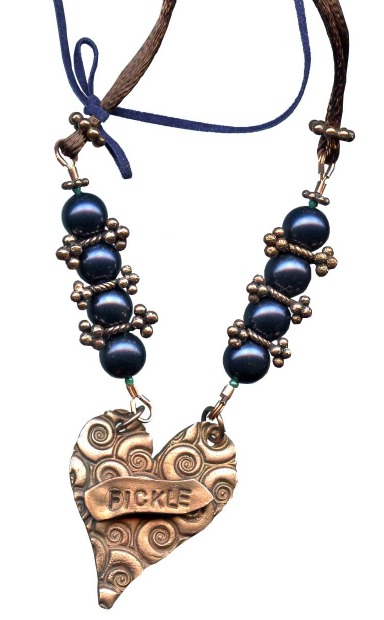
Fickle heart necklace

Finished "Fickle" copper clay necklace

I picked Fickle because I love working with COPPRclay.  Yes, you need a kiln (I bought the Caldera).  I know that is an obstacle for a lot of people as kilns aren’t exactly cheap.  Best to view it as an investment rather than an impulse buy.  But once you have it, all kinds of jewelry-making doors are open to you: fused glass, ceramics, enameling and, of course, metal clay!

I made the Fickle heart pendant during an in-house training session.  Since it was my first time working with COPPRclay, I didn’t have any big goals in mind when I started.  I just wanted to see how the copper clay behaved compared to bronze clay and silver clay.  I was really happy with its workability.  It took textures easily and didn’t dry out too quickly.  It was easy to connect pieces with a little slip.  As you can see, we had a full range of tools and textures and other fun things to play with.
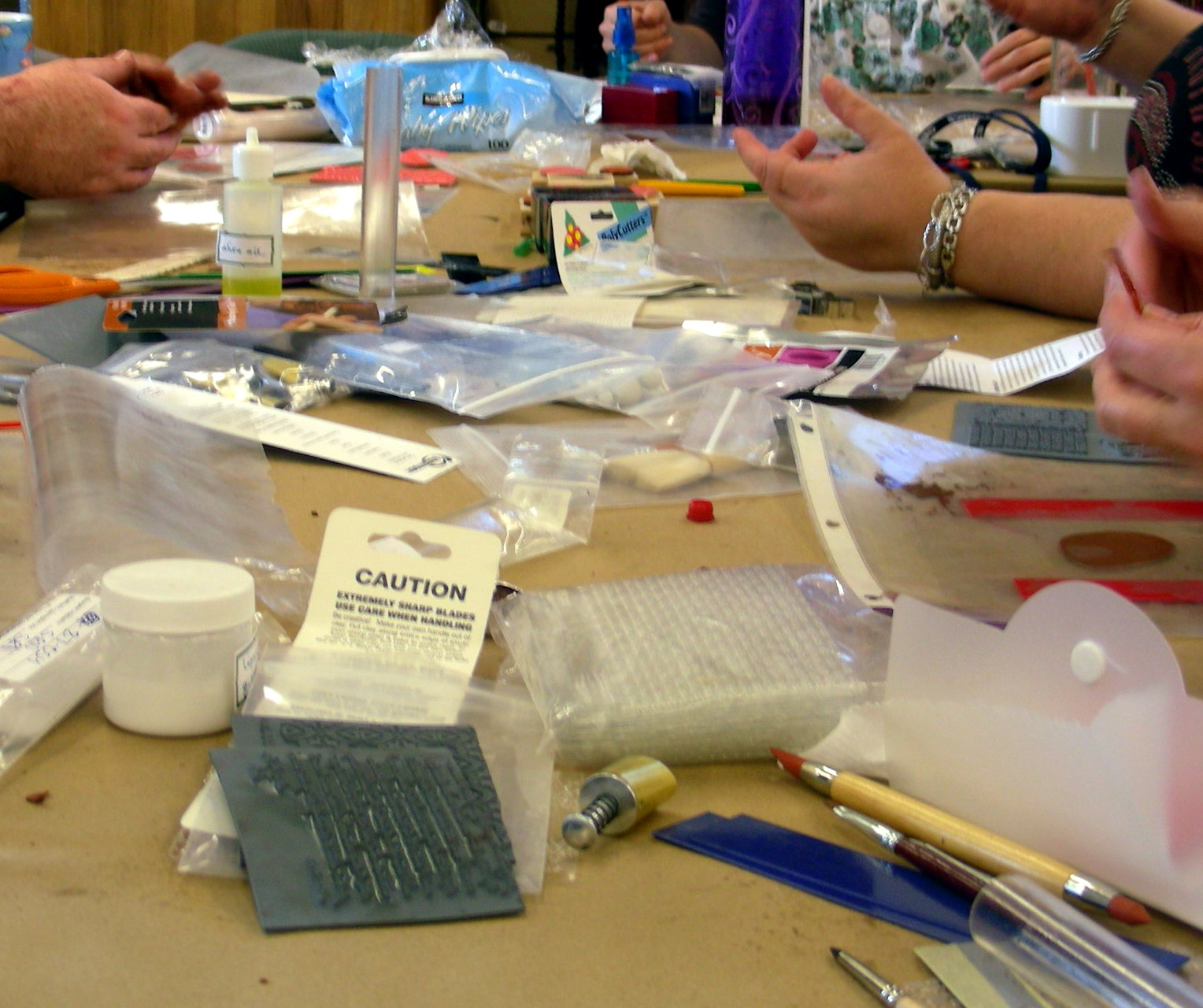
clay chaos

copper clay workshop supplies

I don’t know why I wrote “fickle” on the clay.  I had just finished a trail run, despite my insistence that I am not a runner, so maybe my subconscious was just acknowledging what the world already knows: I change my mind every 3.2 seconds.

Anyway, I just Googled the phrase “fickle heart” in the hopes that there was a meaningful, well-known quote I could claim as my inspiration.  There wasn’t.  But, I learned that the Brit band Sniff ‘n’ the Tears released their first album, titled Fickle Heart, in 1978, which just so happens to be the year I was born.  How’s that for serendipity?
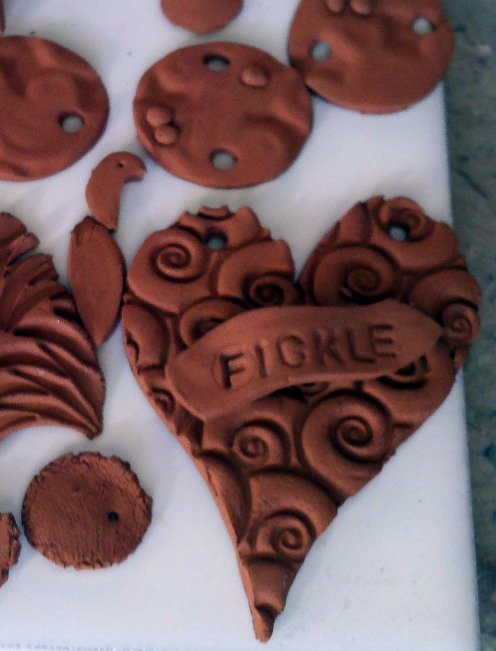
COPPRclay before being fired

COPPRclay before being fired

I hung my fickle little heart with night blue Swarovski crystal pearls, using dotted copper ring beads as spacers.  The back of the necklace is two strands of silky rattail.  I really wish rattail wasn’t called rattail — it is such an unappealing name for such a nice, soft, affordable cording.  The only drawback to working with rattail is its tendency to fray when you cut the ends, but that is easily solved by wrapping a little piece of tape around it before you cut.   Dabbing a bit of glue on the cut end also works.

Whether you are fickle like me or constant and true in your affections, I highly recommend COPPRclay as a way to create jewelry that is personally meaningful.  Have fun creating your own designs!